 AI WEATHER AND
Crew transfer weather windows, checked against your vessel's limits
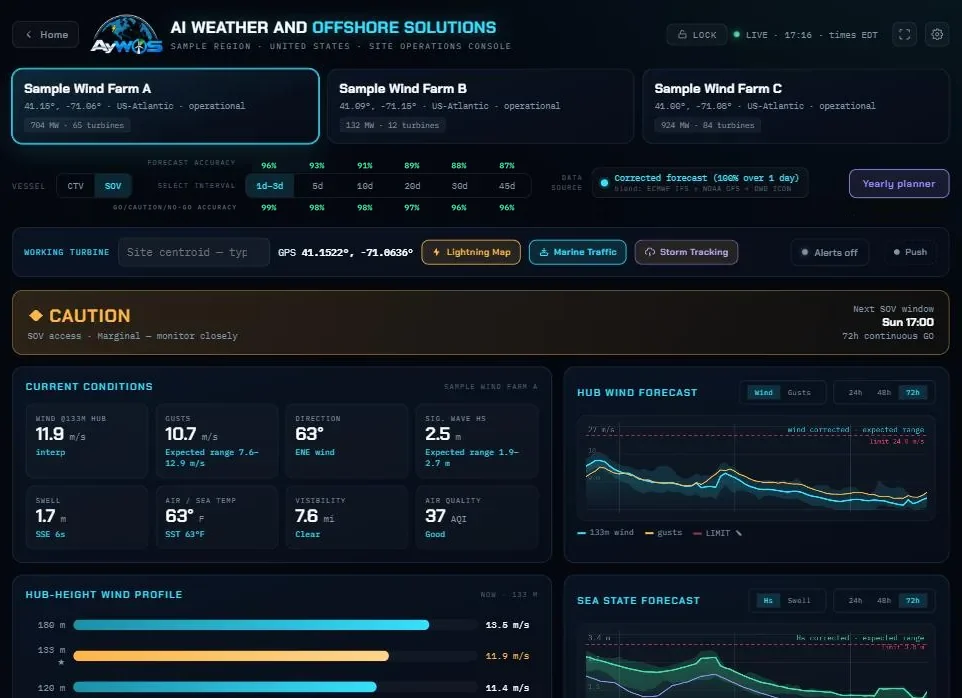
Choose the crew transfer vessel or the service operation vessel and every hour of the next 72 is judged against that vessel's own limits: wind at hub height, gusts, significant wave height and wave period. GO, CAUTION or NO-GO — and when the next window opens.
Your limits, not a generic threshold
Transfer limits belong to the vessel, the access system and the master, not to a weather service. Each operator enters its own limits for each CTV and SOV, and the console applies them hour by hour. As rough guides only:
| Access | Typical wave limit (Hs) | Also limited by |
|---|---|---|
| CTV, bow transfer | about 1.2 to 2.0 m, often quoted as 1.5 m | wave period, swell direction, wind |
| SOV, motion-compensated gangway | about 2.5 to 3.0 m | vessel motions, gangway limits |
| Work at height on the turbine | — | hub-height wind and gusts, lightning |
The vessel master and your marine procedures always decide; these figures only show why one threshold cannot fit every vessel.
Significant wave height is an average: plan for the bigger waves
Hs is the mean of the highest third of the waves. In a sea of Hs 1.5 m, about one wave in ten is near 1.9 m, one in a hundred near 2.5 m, and over a few hours the largest can approach twice Hs — about 3 m. Short, steep waves close a bow-landing window sooner than long swell of the same height, which is why the period is judged as well as the height.
When does the next window open?
The console gives the verdict now, the hour-by-hour picture for 72 hours, the time the next window opens and how long it stays continuous — the question the morning call is really about. Marginal hours are shown with their expected range, so a CAUTION means the forecast straddles your limit.
Planning campaigns weeks ahead
For maintenance campaigns and vessel charters, the 45-day outlook and the yearly planner show which weeks are likely to be workable, and the accuracy panel shows how much weight those long leads can carry.
Questions
What wave height can a CTV transfer in?
It depends on the vessel, the transfer system and the master's judgement. Bow transfers are commonly limited to about 1.5 m significant wave height, some vessels more and some less. AyWOS applies the limits you enter for each vessel.
What is the difference between CTV and SOV limits?
A crew transfer vessel pushes its bow against the turbine's boat landing, so waves and their period limit it early. A service operation vessel uses a motion-compensated gangway and typically works in higher seas, around 2.5 to 3 m.
Does AyWOS decide whether a transfer goes ahead?
No. It supports the decision with forecasts judged against your limits; the vessel master and your site personnel make the call.
Related
See tomorrow's windows for your vessels.
Tell us your sites and vessels and we will show you the console on your own wind farm.